Gambardella
Lab
The living grammar of proteins — variation, constraint, and function, read at proteome scale.
See our research →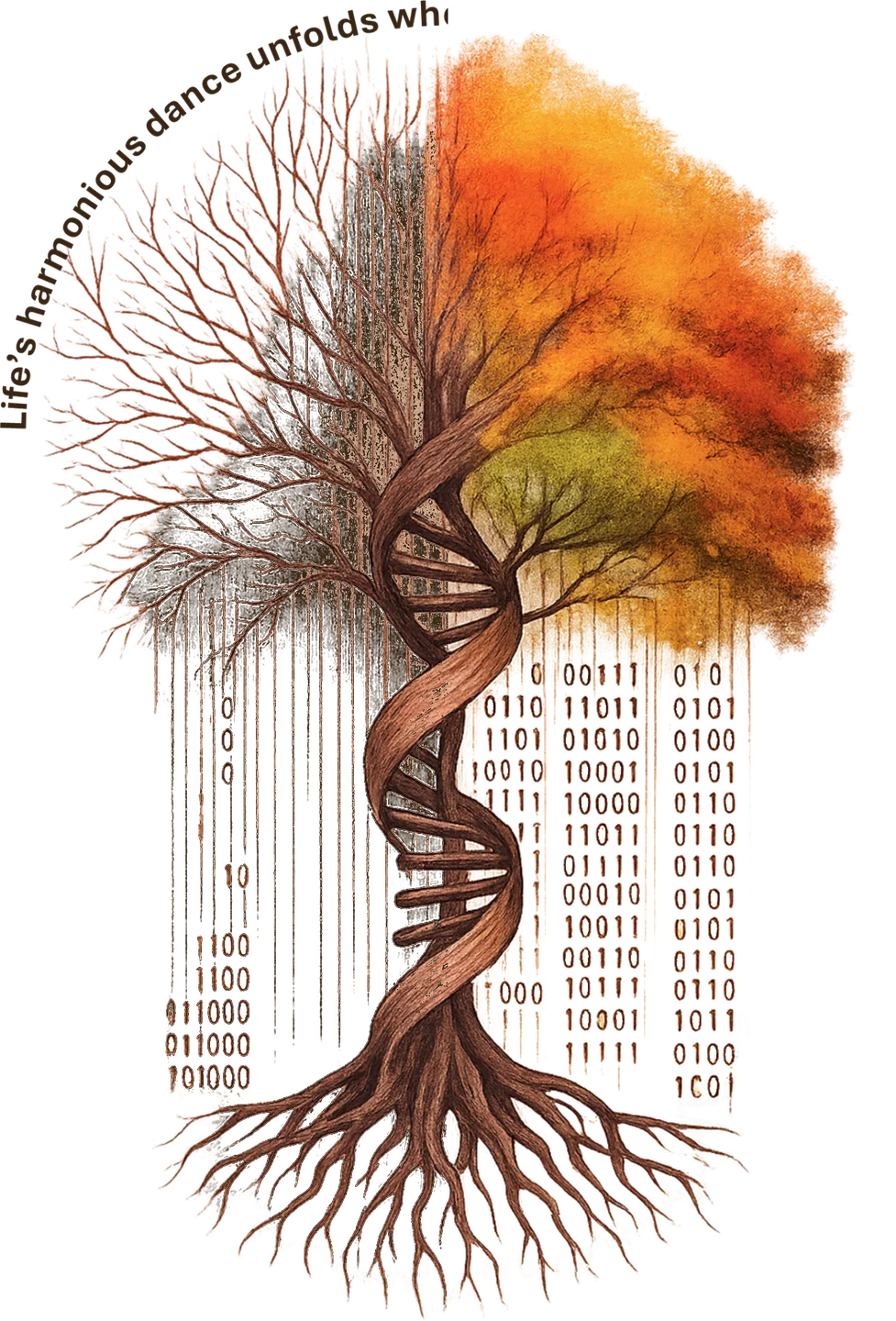
Reading the
mutational language
of proteins.
AI models — including ESMRank — that turn billions of mutations into one transferable signal of constraint.
Software & code →Life's harmonious dance unfolds where nature and technology intertwine.
Like the tree of life — rooted in complexity, branching toward discovery — our research integrates DNA sequencing and artificial intelligence to reveal how genetic variation shapes human health. By turning binary code into biological insight, we work to accelerate diagnoses, guide therapies, and expand the promise of precision medicine.
Rooted in biology
Real sequencing data, real disease — from single cells to whole proteomes.
Branching through AI
Protein language models that read mutations the way evolution wrote them.
Toward precision medicine
Turning constraint into interpretation — diagnoses, therapies, better proteins.
From sequence to mechanism, at scale.
Self-supervised protein models give us a score for every possible mutation. Our work makes those scores transferable, interpretable, and tied to real biology.
Variant effect prediction
Language-model scores for all ~450M possible human missense variants — no homologs, no clinical labels required.
Mutational constraint from MAVEs
ESMRank reconciles ~1,100 overlapping deep mutational scans (>2M variants) into one transferable axis of constraint — variant soundness.
AI for protein engineering
Ranking and designing sequence variants for stability, fitness and function with protein foundation models — and generative models that build new protein 3D structures.
From variants to diagnosis and therapy
Finding variants with hybrid long/short-read sequencing, interpreting them with AI, and linking them to folding, function and therapeutic rescue — from CFTR in cystic fibrosis to inherited retinal disease.
Haplotypes for allele-specific therapy
Targeted long-read sequencing and phasing in KIF1A-associated neurological disorder, to tell which patients carry an allele configuration compatible with allele-specific antisense therapy — and to find new SNPs that could extend it to more patients. In collaboration with, and with thanks to, KIF1A Italia.
Genome-editing outcomes, molecule by molecule
Long reads and a dedicated pipeline to reconstruct what therapeutic genome editing actually wrote into the genome: where the donor DNA integrated, in which orientation, whether it is complete, and how often — a structural safety check for gene therapy.
Open tools, built for real data.
Everything we publish ships with code. Below: a live read of the mutational landscape our models score, and the tools behind our work — each with install notes and citation on the Software page.
A learning-to-rank predictor of missense variant effects, trained on ~1,100 overlapping deep mutational scans fused into one consensus score — variant soundness. ESM2 embeddings plus physicochemical features; tracks ClinVar pathogenicity and CFTR folding, activity and drug response.
Recent work.
The lab.
A small group of computer scientists and biologists working across machine learning, genomics and protein science.
Gennaro Gambardella
PI at TIGEM and tenure-track Assistant Professor at Scuola Superiore Meridionale. Works at the interface of AI, genomics and protein biology. Editorial Board member, Scientific Data. From January 2027, Head of the TIGEM Bioinformatics Core.
PhD TIGEM / Univ. Naples → IEO Milan → King's College London → TIGEM PI · SSM
Riccardo Arnese
PhD in Computational and Quantitative Biology, University of Naples. Lead author on ESMRank — best poster at EMBO | EMBL "AI and biology" and best talk at ISCB-UK, both 2026.
Harsh Poddar
Long-read haplotype phasing in KIF1A-associated neurological disorder, to match patients with allele-specific antisense therapies.
Antonio De Francesco
Genome integrity after gene editing: long-read reconstruction of where and how therapeutic DNA integrates.
Giovanni Plazzotta
PhD in Systems Medicine (SEMM), second year. Generative models of protein 3D structures: flow matching that starts from homology-informed source structures.
Gaetano Viscido
Now postdoctoral researcher in the Califano Lab, Columbia University.
Melania Franchini
Now postdoctoral researcher in the Califano Lab, Columbia University.
Simona Pellecchia
Single-cell genomics and tumour heterogeneity; lead author of the anti-EGFR lineage-tracing study (Genome Medicine, 2024).
Xabier Bujanda Cundín
Now a PhD student at the University of Pamplona. Co-author of the retinitis pigmentosa gene-insertion study (Cell Reports Medicine, 2026).
What's happening in the lab.
Working on AI for proteins? Let's talk.
We welcome motivated students and postdocs in machine learning, computational biology and protein science — and collaborations on variant interpretation and protein engineering. Reach out with a short note on what you'd like to work on.